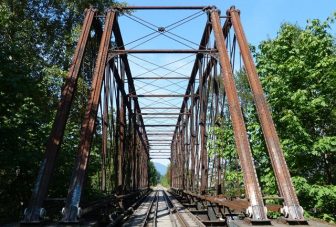
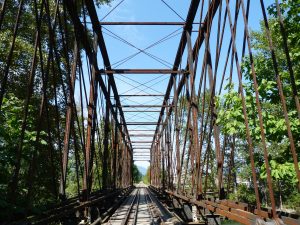
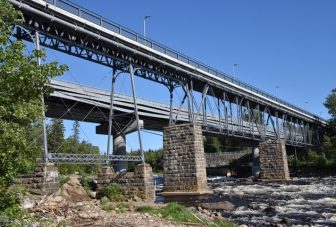
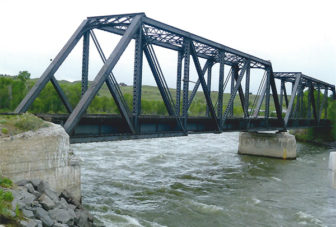
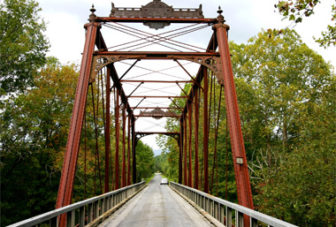
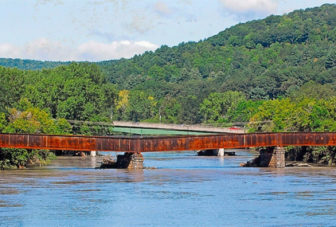
This photography by Nathan Holt shows the Cowichan River Railway Bridge. Installed in 1907, this bridge has a rare design of double Phoenix columns, with a pair of trusses on each side of the track. It is the only bridge like this in North and South America. To learn more about this unique bridge, visit historicalbridges.org.
Shannon Bridge
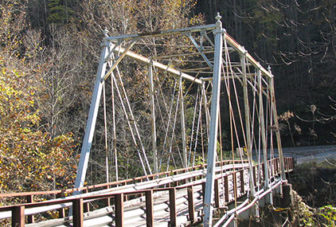
Preserved for pedestrian use, this ancient iron bridge is one of the only known truss bridges in Canada with the rare Phoenix columns. The bridge was originally built as a railway bridge but eventually abandoned by the railway and ownership of the bridge passed to the municipality in 1929 who converted it for vehicular use in 1931-1932. It served vehicular traffic until 2015 when a new highway bridge was built next to the heritage bridge. At this time, the heritage bridge was restored and preserved for pedestrian use. This bridge is one of the most important heritage bridges in Canada due to its age, use of Phoenix columns, and outstanding historic integrity. The only major alteration is replacement of some of the sway bracing Phoenix columns with welded replacements. However, the truss lines remain unaltered, and even the deck stringers remain original with Phoenix Iron still clearly visible on the beams. The bridge is composed of two large approximately 126 foot pin-connected Pratt deck truss spans which make use of Phoenix columns in their members and chords. There are also shorter approximately 43 foot rivet-connected Warren deck truss approach spans. These spans are also a design used by the Phoenix Bridge Company and they are among some of the oldest rivet-connected truss spans in Canada, since pin connections were more common at this time. The approach spans are supported by bents that also use Phoenix columns.
Phoenix Bridge
Tug Fork Bridge
Built by the Phoenix Bridge Company, the bridge is located in a mountainous area in McDowell County and crosses the Tug Fork. The original date that the bridge was built is not known, but the bridge is still in use for vehicular traffic.
Photograph by Barbara Cohen
Old Route 61 Wolf Creek Bridge
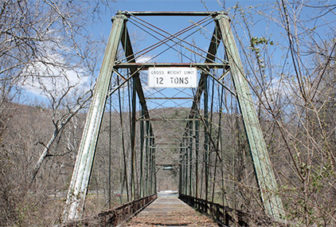
The Phoenix Bridge Company originally built this as a railroad bridge. It was converted to vehicular traffic in 1946, but is now a popular pedestrian crossing. It is listed on the National Register of Historic Places, and is located in Bland County.
Photograph courtesy of Wikipedia
Hawthorne Street Bridge
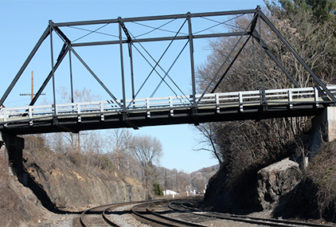
This Phoenix Column Bridge was constructed for what has now become the CSX Railroad, and crosses over the street in Covington. It is still in use.
Photograph courtesy of Wikipedia
Gleaves Road Bridge
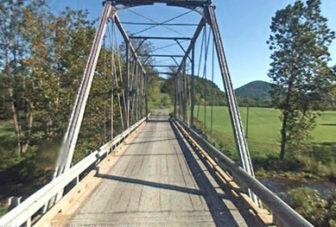
This bridge crosses the Cripple Creek on Route 619 in Wythe County. Built by the Phoenix Bridge Company, it was originally a railroad bridge with Pratt trusses and Phoenix Columns. It has now been rehabilitated and is owned by the VA DOT.
Photograph courtesy of Google
Francis Scott Key Bridge
This iconic bridge crosses the Potomac River connecting Washington, DC with Arlington, VA. It was built by the Army Corps of Engineers in conjunction with the Phoenix Bridge Company.
Photograph courtesy of Wikipedia
Botetourt Bridge at Eagle Rock
Originally built by the Phoenix Bridge Company as a railroad bridge, it is located in the western part of the state, SW of Roanoke. It was the only bridge that withstood a tornado in 1987 so it was resurfaced and restored for vehicular traffic.
Photography by Barbara Cohen
White River Junction Railroad Bridge
This steel plate bridge was manufactured by the Phoenix Bridge Company and is still in use for both passenger and freight service.
Scanned postcard image – Courtesy of Steel Wheels Photography